Peter's electronic projects Peter's electronic projects
 Try it now, before building! Click on the transmitter buttons with the
green
labels
on the left and see how the receiver outputs (K1-K8) change. Change
the number of transmitter or receiver channels. Switch the receiver
output type between latched and momentary.
Try it now, before building! Click on the transmitter buttons with the
green
labels
on the left and see how the receiver outputs (K1-K8) change. Change
the number of transmitter or receiver channels. Switch the receiver
output type between latched and momentary.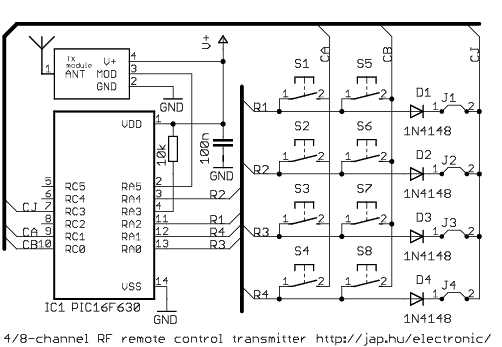
| part | description |
| C1 |
100nF ceramic capacitor |
| R1 |
10k resistor (1/8W) |
| D1-D4 | 1N4148 diode (optional) |
| S1-S8 |
tact switch, DTSM 61N or similar |
| IC1 | PIC16F630 or PIC16F676 microcontroller, pre-programmed |
| TXMOD |
radio
transmitter module, see text (hardware) |
| B1 |
battery between 2-5.5VDC (check TXMOD specs for valid voltage range) |
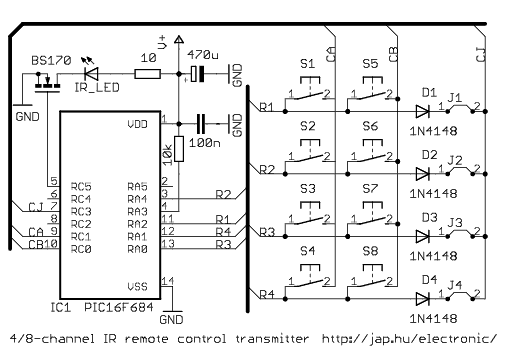
| part | description |
| C1 |
100nF ceramic capacitor |
| C2 |
470 uF 6.3V, electrolytic
capacitor |
| R1 |
10k resistor (1/8W) |
| R2 |
10 ohm resistor (1/4W) |
| D1-D4 | 1N4148 diode (optional) |
| D5 |
IR transmitter LED |
| Q1 |
BSS138 or similar N-MOSFET |
| S1-S8 |
tact switch, DTSM 61N or similar |
| IC1 | PIC16F684 microcontroller, pre-programmed |
| B1 |
battery between 2-5.5VDC (CR2032, 3.6V LiIon battery or 3xAA
batteries) |
| please
observe the corresponding address configuration! |
|
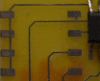 transmitter: no diodes connected |
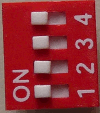 receiver: switches all ON |
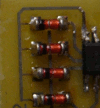 transmitter: all diodes connected |
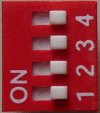 receiver: switches all OFF |
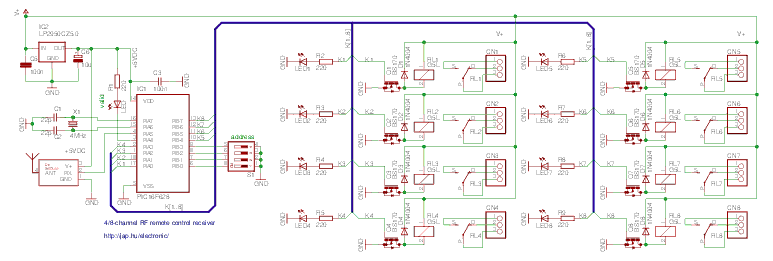
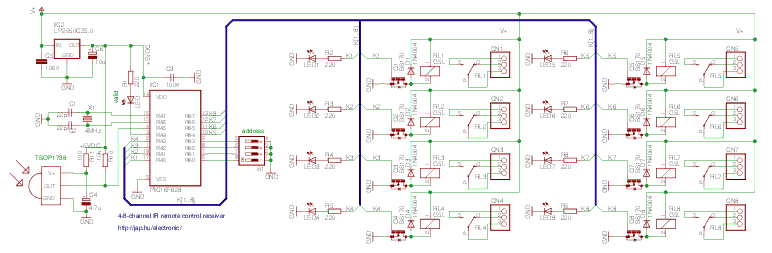
parts list
| part | description |
| C1, C2 | 22pF ceramic capacitor |
| C3, C5 | 100nF ceramic capacitor |
| C6 | 10uF 6.3V electrolytic capacitor |
| CN1-CN8 | PCB terminal block, 3-way (DG301) |
| D1-D8 | 1N4004 diode |
| IC1 | PIC16F627 or PIC16F628 or PIC16F627A or PIC16F628A microcontroller, pre-programmed |
| IC2 | LP2950CZ5.0 voltage regulator |
| LED | 3mm LED (green) |
| LED1-LED8 | 3mm LED (red) |
| Q1-Q8 | BS170 N-channel mosfet transistor |
| R1-R9 | 220R resistor (1/8W) |
| RL1-RL8 | G5LE relay, see text for coil voltage selection |
| S1 | piano DIP switch, 4-way |
| X1 | 4MHz HC49 crystal |
| RXMOD | 3-pin radio receiver module, see text (hardware) |
| please
observe the corresponding address configuration! |
|
| transmitter: no diodes connected |
receiver: switches all ON |
| transmitter: all diodes connected |
receiver: switches all OFF |
Understanding VGHD Player: The Legacy of High-Definition Virtual Gaming
In the mid-2000s, the landscape of digital media was undergoing a massive shift. As high-definition video became the new standard, specialized software emerged to bridge the gap between classic gaming experiences and modern display capabilities. Among these tools, the VGHD Player (Virtual Game High Definition Player) carved out a niche for enthusiasts looking to elevate their media consumption.
While technology has moved toward unified streaming and cloud gaming, the VGHD Player remains a point of interest for digital historians and tech enthusiasts. Here is everything you need to know about its functionality, its impact, and its place in the evolution of media players. What is VGHD Player?
At its core, VGHD Player was designed as a multimedia playback engine specifically optimized for high-definition "virtual" content. Unlike standard players like VLC or Windows Media Player, which focus on broad compatibility, VGHD was often associated with specific interactive media formats and high-fidelity video streams that required specialized decoding.
The "Virtual Game" prefix suggests its roots: a tool intended to handle the cinematic sequences, FMVs (Full Motion Videos), and interactive environments common in the transition period between the PlayStation 2 era and the HD era of gaming. Key Features of VGHD Player
High-Definition Optimization: In an era where hardware acceleration was still maturing, VGHD Player utilized specific codecs to ensure smooth playback of 720p and 1080i video without stuttering on mid-range hardware.
Resource Efficiency: It was built to be lightweight. By stripping away the bloat of larger media suites, it dedicated maximum CPU and GPU power to the video rendering process.
Specialized Codec Support: It often came bundled with proprietary or rare codecs that allowed users to view high-quality "virtual" files that weren't natively supported by standard operating systems.
Interactive Overlays: Some versions of the player supported interactive layers, allowing for a "game-like" experience where users could trigger events within the video stream. The Evolution of HD Playback
The rise of the VGHD Player coincided with the "HD Wars" (Blu-ray vs. HD-DVD). During this time, users were desperate for software that could handle high-bitrate files without crashing. VGHD filled this void by providing a stable environment for experimental video formats.
However, as the H.264 (and later H.265/HEVC) standards became universal, the need for specialized "virtual game" players began to wane. Modern players eventually integrated the hardware acceleration features that once made VGHD unique. Is VGHD Player Still Relevant? Today, the VGHD Player is primarily used by:
Retro Tech Enthusiasts: Those running legacy hardware (Windows XP or Vista) who need a player compatible with older system architectures.
Archivists: People looking to open specific "virtual game" files or legacy interactive media found in old digital archives.
Media Hobbyists: Users who prefer the aesthetic and simplicity of mid-2000s software interfaces. Safety and Downloads
If you are looking to download VGHD Player today, exercise caution. Because it is legacy software, it is no longer updated by its original developers. Always ensure you are downloading from a reputable software archive and scan all files for malware, as many "free player" downloads on the internet can be bundled with unwanted adware. Conclusion
The VGHD Player serves as a fascinating snapshot of a time when high-definition video was a frontier rather than a standard. It paved the way for the seamless, high-fidelity streaming experiences we enjoy today on platforms like YouTube and Twitch. While it may no longer be the powerhouse it once was, its contribution to the world of virtual media playback is undeniable.
The Problem:
Most modern players sacrifice compatibility for features. Try playing an old DV camcorder rip or a 10-bit anime encode—suddenly, you need filters. vghd player
The Solution:
VGHD (Very Good High Definition) strips the OS to the bone. It uses mpv as a backend with a custom UI written in Rust/SDL2.
Core Philosophy:
.exe / .app file. No registry entries.Current Build Status:
Download the Alpha: vghd-player-alpha-v0.3.tar.gz
If VLC is the Swiss Army knife, VGHD Player is a single, sharp obsidian blade. Let’s compare them head-to-head:
| Feature | VLC Media Player | VGHD Player | | :--- | :--- | :--- | | CPU Usage (1080p) | High (40-70% on old dual-cores) | Low (5-20% on same hardware) | | RAM Usage | ~150-200 MB | ~35-60 MB | | Interface | Full UI with menus (skinnable) | Zero UI (black screen only) | | Playback Controls | Mouse + Hotkeys | Hotkeys only (mouse optional) | | Streaming/Network | Yes (RTSP, HTTP, etc.) | No (Local files only) | | DVD/Blu-ray Menu | Yes | No | | Conversion Tools | Yes (Record/Convert) | No | | Best For | General purpose, streaming, discs | Low-end PCs, high-bitrate local files |
The Verdict: If you need to play a DVD menu or watch an online stream, use VLC. If you have a $100 laptop from 2012 and want to watch a 10GB MKV file without your fans sounding like a jet engine, use VGHD Player.
In an age of data breaches and spyware, it is responsible to ask: Is VGHD Player safe?
The short answer: Yes, provided you download it from the official source.
The long answer: Unlike some freeware that harvests your browsing history, VGHD Player is open-source (most versions). The source code has been audited by independent developers on GitHub. It does not:
However, beware of "VGHD Player Pro" or "VGHD Player 2025" pop-up ads on third-party download sites. These are scams. The real VGHD Player is 100% free and will never ask for a credit card.
"VGHD Player" is a textbook example of a potentially unwanted program (PUP) or an outright malicious trojan. It does not exist in any legitimate software catalog, its name is an opaque lure, and its purported purpose is technically redundant in an era of robust open-source media frameworks.
The only safe and correct response to encountering a request for "VGHD Player" is to delete the source file (the video that prompted the search) and run a full antivirus scan. Users should adhere to a strict digital hygiene rule: If a file won't play in VLC, the file is the problem—not a lack of specialized software. Downloading unknown "players" is not a solution; it is an invitation to a cyberattack.
VGHD Player refers to a streamlined, distraction-free media player designed for high-definition playback. While "VGHD" is also the executable name for VirtuaGirl software, the standard VGHD Player is a standalone utility optimized for smooth performance and low resource usage. Core Features
High-Definition Playback: Supports smooth HD video using hardware acceleration when available.
Precision Control: Includes frame-stepping, playback speed adjustments, and A–B repeat for focused content review. Frame perfect: No dropped frames on 4K @ 60fps
Flexible Management: Features quick-resume, multi-track audio support, and subtitle compatibility.
Lightweight Design: Built for fast startup with a small system footprint. Installation and Setup
System Requirements: The software is primarily designed for Windows environments.
Deployment: It typically installs to C:\Program Files\VGHDPlayer2\ by default.
File Support: It handles a wide variety of formats beyond standard video, including multimedia and programming extensions such as: Video/Audio: .mp4, .3gp, .avi, .aac, .wav.
Other: .doc, .csv, and even various source code files like .cpp and .cs. Quick Usage Guide
Configuring Shortcuts: Users can set up custom keyboard shortcuts for most playback functions to improve workflow.
Capturing Content: Use the built-in screenshot capture tool to take stills during video playback.
Looping: Utilize the A–B repeat function by marking a start (A) and end (B) point on the playback timeline to loop specific segments. Troubleshooting Tips
Unsupported Formats: If a file won't open, verify it matches the Compatibility List or attempt to convert it to a standard MP4 format.
Performance Issues: Ensure hardware acceleration is enabled in the settings menu to reduce CPU load during 4K or high-bitrate playback.
If you are actually looking for help with the Virtual Guitarist (VG) series by UJAM or Steinberg, tell me, and I can provide specific instructions for Player Mode vs. Instrument Mode chord handling. VGHD Player - Software Library - PC Matic
"VGHD Player" refers to software associated with the VirtuaGirl platform (which later rebranded as iStripper). The acronym VGHD stands for VirtuaGirl High Definition.
Below is a detailed breakdown of what the VGHD Player is, its history, functionality, and the context in which it is used.
If you want, I can convert this into a one-page product brief, UI mockup list, or a prioritized backlog.
Today, the VGHD player is considered "abandonware." The official servers that verified the cards have largely gone offline Current Build Status:
list the VGHD Player in their software libraries. While not always classified as a virus, it is often flagged for performance issues or as "adware-adjacent" due to its background processes. System Performance
: Users often report that the player or its associated downloader ( vghd_downloader.exe ) can cause system sluggishness. Technical advisors on JustAnswer suggest checking the Task Manager
to see if these executables are consuming excessive resources. JustAnswer Troubleshooting & Removal Tips
If the VGHD Player was installed without your direct intent or is causing issues, consider these steps: Check Startup Programs
or the Task Manager "Startup" tab and uncheck "vghd" or "vghd downloader" to prevent them from running when your computer starts. Complete Uninstallation
: Look for the program in your Windows "Programs and Features" list. Common installation paths include: C:\vghd\VGHD Player\ C:\Program Files (x86)\VGHD Player\ Scan for Adware
: Since it is often bundled with other downloads, running a scan with a dedicated adware removal tool can help ensure all associated files are removed. JustAnswer Distinction from Financial Terms Be careful not to confuse "VGHD Player" with the
(Vanguard Diversified High Growth Index Fund). If you were looking for investment insights regarding Vanguard's diversified funds, experts from
provide detailed comparisons on their growth and risk profiles. how to safely remove this specific software from your system? What is up with desktopvideoplayer main executable?
Post Title: 🎬 VGHD Player – The Lightweight Video Player You Might Have Missed
Post Body:
Looking for a simple, no-frills video player that just works? Say hello to VGHD Player 👋
🔹 What is it?
A compact, open-source video player designed for low resource usage. Great for older hardware or anyone who hates bloated software.
🔹 Key features:
✅ Plays most common formats (MP4, AVI, MKV, etc.)
✅ Minimal interface – no distracting menus
✅ Portable version available (no installation needed)
✅ Low CPU & memory usage
⚠️ Note: VGHD is relatively obscure. Some downloads online may be outdated or bundled with adware. Always get it from trusted sources like GitHub or portable app repositories.
💬 Have you used VGHD Player? Share your experience below! Or drop your favorite lightweight video player in the comments. ⬇️
#VGHDPlayer #VideoPlayer #OpenSource #LightweightSoftware
LATCH_MASK EQU B'00001111' sets channels 8-5 to momentary
and
channels 4-1 to latched (toggle) mode. Then use the compiler (MPLAB or
gputils) to
assemble the code.clrf
0x91 ;
ANSEL