

|
Vengaiyin Maindhan Novel Download !!top!! Pdf |
Небольшая ознакомительная часть, чтобы понять, с чем собственно придётся иметь дело, и стоит ли вообще начинать. Ниже будет изложено моё личное мнение, которое не претендует на истину в первой инстанции. Людей много и вкусы у всех разные. Тем не менее как человек имеющий опыт работы в этой системе проектирования я могу дать свою оценку.
Начну пожалуй с того, что начинающему 3D проектировщику стоит определиться с целью использования CAD. Если ваша цель это мультимедиа и скульптура - данный CAD вам не подойдёт (если только вы не работаете в жанре примитивизма, кубизма или не собрались сделать 3D модель свинки ПЕПЫ). Если вы хотите проектировать технические объекты относительно невысокой сложности вы на верном пути... Посмотрим с чем мы имеем дело.
щелчком мышкиснять фаску с грани - не получится, надо нехило так извернуться.
тормозятв окне пред просмотра, а рендеринг сложных моделей (получение итогового STL файла) может занимать до 5-10 минут, по крайней мере на моей
пишущей машинке. Но это и понятно - работа с графикой всегда была ресурсозатратным делом. Частично решить проблему можно убавив количество граней на время отладки модели.
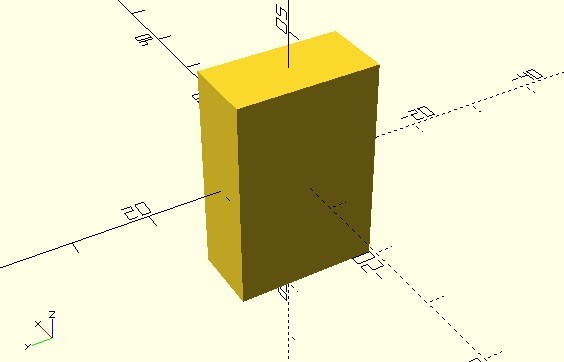
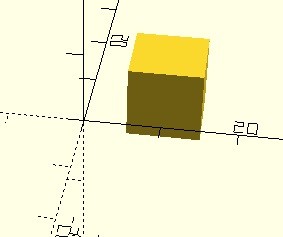
Параллелепипед с длинами сторон по X, Y, Z соответственно 10, 20, 30 в мм:
cube( size=[10,20,30], center=true );true/false - располагать по центру или в положительных полуосях. Короткие варианты написания кода: cube( [10, 20, 30], true ); cube( [10, 20, 30] );если последний параметр не указан принимает значение false a = [10, 15, 20]; cube(a);здесь a - параметр (матрица) содержит в себе значение сторон cube( 5 );куб стороной 5мм в положительных полуосях; |
 |
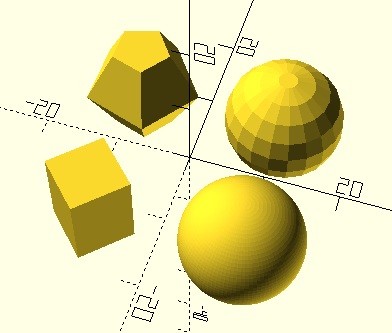
Сфера радиусом 8 мм, с разным разрешением $fn.
sphere(r=8, $fn=100); // Полное написание
sphere(8, $fn=20); // Короткое написание
sphere(8, $fn=4);
sphere(8, $fn=5);
Центр сферы всегда в начале координат. Вместо $fn можно задать параметр $fa - угловое разрешение и $fs - размер грани в мм. sphere(d=16, $fn=100); // Задать сферу через диаметр |
 |
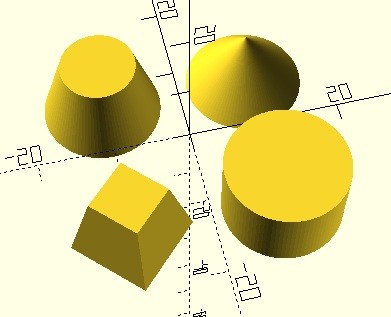
Через цилиндр можно задать конус, усечённый конус, пирамиду, усечённую пирамиду.
Первый параметр высота цилиндра, следующие это нижний радиус, верхний радиус, центровка и число граней $fn.
cylinder(h=10, r1=8, r2=5, center=true, $fn=100); // полное написание
cylinder(10, 8, 0, true, $fn=100); // краткое написание
cylinder(10, 8, 8, true, $fn=100);
cylinder(10, 8, 5, true, $fn=4);
Варианты написания: cylinder(h=10, d1=16, d2=10, true, $fn=100);// через диаметры оснований cylinder(h=10, r1=8, d2=10, true, $fn=100);// через радиус и диаметр онований cylinder(h=10, r=8, true, $fn=100);// если нужен просто цилиндр |
 |
|
Многогранник.
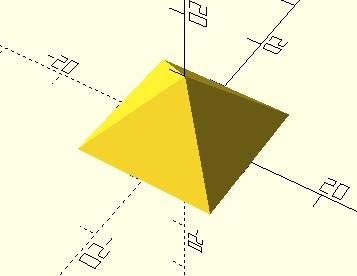
Через эту функцию можно задать любую поверхность. На практике используется редко. Почему? Думаю поймёте сами. Постройка пирамиды. Что требуется? Задать все вершины фигуры (points) в координатах [x, y, z]. Затем объединить в группу по 3 - получить треугольники, играющие роль граней (faces) многогранника. polyhedron( points=[ [10,10,0], [10,-10,0], [-10,-10,0], [-10,10,0], [0,0,10] ], faces=[ [0,1,4], [1,2,4], [2,3,4], [3,0,4], [1,0,3], [2,1,3] ] );Точки (points) с координатой z=0 - это вершины основания пирамиды, a последняя с x=0, y=0, z=10 - это пик пирамиды. Грани (faces) [0,1,4], [1,2,4], [2,3,4], [3,0,4] - это боковые треугольные грани, а последние две [1,0,3], [2,1,3] задают квадрат основания. Цифры в квадратных скобках, говорят какие точки объединить. Соответственно точки по порядку их следования 0 -> [10,10,0] , 1 -> [10,-10,0] и т.д. |
 |
Перемещение объекта на x=10, y=10, z=0 относительно центра координат:
translate([10,10,0]) cube(10, true);Если нужно переместить группу объектов заключаем их в фигурные скобки: translate([10,10,0]) {/*Здесь код группы*/};
Применение нескольких вложенных переносов:
translate([10,10,0]) {
  cube(10, true);
  translate([0,0,5]) sphere(5, $fn=50);
};
Эквивалент примера выше:
translate([10,10,0]) cube(10, true); translate([10,10,5]) sphere(5, $fn=50); |
 |
|
Вращение.
На 75 градусов вокруг оси X: rotate([75,0,0]) cube(10, true);Вращение группы объектов: rotate([75,0,0]){/*Здесь код группы*/};
Вращение + перемещение.
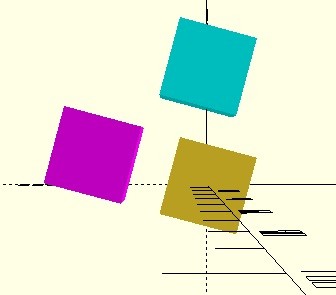
Две нижние строчки: color([0,1,1]) translate([0,0,15]) rotate([75,0,0]) cube(10, true); color([1,0,1]) rotate([75,0,0]) translate([0,0,15]) cube(10, true);Дают разные результаты. Имеет значение последовательность действий. Бирюзовый куб сначала повёрнут на 75 градусов вокруг оси X, а потом смещён на 15 мм по оси z. Сиреневый куб сначала смещён на 15 мм, а потом повёрнут. |
 |
Сложение (объединение).
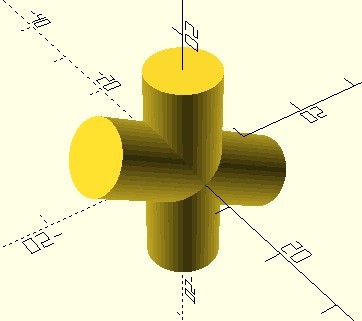
union(){
  cylinder(30, 5, 5, true, $fn=50);
  rotate([60,0,0]) cylinder(30, 5, 5, true, $fn=50);
};
Любое количество простых или сложных объектов в фигурных скобках будут объединены.
|
 |
|
Вычитание (разность).
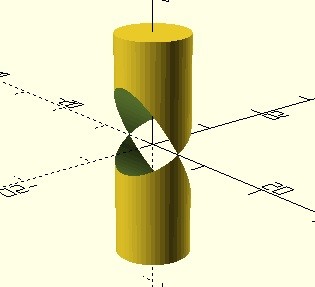
Из простого объекта указанного первым будут вычитаться все что указано ниже него. difference(){
cylinder(30, 5, 5, true, $fn=50);
rotate([60,0,0]) cylinder(30, 5, 5, true, $fn=50);
};
Из составного объекта указанного первым будут вычитаться все что указано ниже него.
difference(){
  union(){cylinder(30, 5, 5, true, $fn=50); cube(10, true);};
  rotate([60,0,0]) cylinder(30, 5, 5, true, $fn=50);
};
|
 |
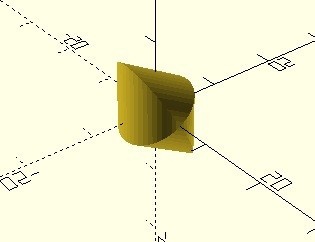
Произведение (пересечение).
У объектов внутри фигурных скобок находится общая часть - она и остаётся.
intersection(){
  cylinder(30, 5, 5, true, $fn=50);
  rotate([60,0,0]) cylinder(30, 5, 5, true, $fn=50);
};
|
 |
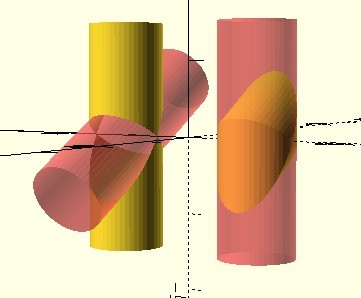
Чтобы сделать объект видимым или прозрачным при вычитании или пересечении, достаточно поставить решётку перед фигурой, объединением и т.п.
Модификатор очень удобен при отладке модели, когда не видно вычитаемых, пересекаемых фигур или если нужно заглянуть внутрь создаваемой модели.
translate([10,0,0]) difference(){
  cylinder(30, 5, 5, true, $fn=50);
  rotate([60,0,0]) #cylinder(30, 5, 5, true, $fn=50);
};
или
translate([-10,0,0]) intersection(){
  #cylinder(30, 5, 5, true, $fn=50);
  rotate([60,0,0]) cylinder(30, 5, 5, true, $fn=50);
};
|
 |
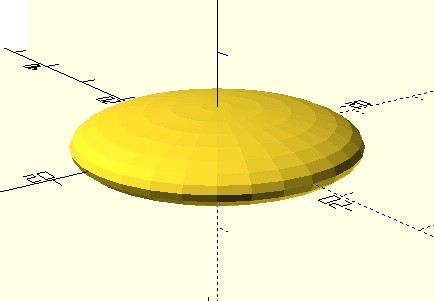
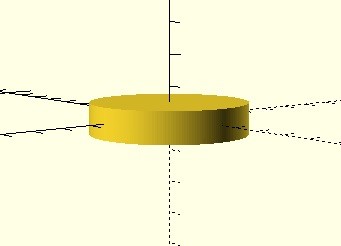
Сжатие. Растяжение.
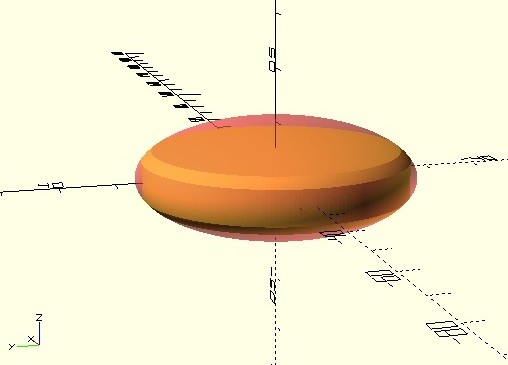
scale([2,2,0.5]) sphere(8, $fn=30);Соответственно по оси X и Y сферу растянули в 2 раза, а по оси Z сжали в 2 раза. |
 |
Title: The Roar of History: Understanding the Legacy of 'Vengaiyin Maindhan'
In the realm of Tamil historical fiction, few names command as much respect as Sandilyan. Known as the "Emperor of Historical Novels," Sandilyan had a unique ability to transport readers back in time, blending authentic history with high-octane adventure and romance. Among his celebrated works, Vengaiyin Maindhan (The Son of the Tiger) holds a special place in the hearts of literature enthusiasts. As the digital age progresses, the search for the "Vengaiyin Maindhan novel download PDF" has surged, reflecting a modern desire to preserve and access classic Tamil literature through technology.
The Plot and Historical Context To understand the popularity of this novel, one must look at its narrative depth. Set in the glorious era of the Chola dynasty, specifically during the reign of the great Rajaraja Chola I, the novel is a tapestry of politics, war, and espionage. The title, Vengaiyin Maindhan, refers to the protagonist who possesses the courage and ferocity of a tiger—an attribute synonymous with the Chola emblem.
The story typically follows a hero who navigates the complex geopolitical landscape of South India and Sri Lanka. Sandilyan was a master of geography and history; his descriptions are not merely decorative but serve as a window into the past. Through the eyes of the protagonist, readers witness the naval supremacy of the Cholas, the intricacies of palace intrigue, and the rugged terrain of ancient battlefields. The novel does not just tell a story; it educates the reader about the administration, weaponry, and culture of a bygone era.
The Literary Significance What sets Vengaiyin Maindhan apart from ordinary adventure novels is Sandilyan’s literary style. His prose is poetic, often described as "Kavidai Urai" (poetic prose). The dialogues are sharp, the emotional arcs are compelling, and the portrayal of women characters is often progressive for the genre, depicting them not just as romantic interests but as brave, intelligent individuals integral to the plot.
The novel serves as an inspiration for patriotism and pride in Tamil heritage. It romanticizes the valor of the ancestors, instilling a sense of history in readers who might otherwise find academic history dry. This emotional connection is why the book remains relevant decades after its initial publication.
The Digital Shift: Why the PDF Search? The frequent internet search for "Vengaiyin Maindhan novel download PDF" highlights a significant shift in reading habits. In the past, readers relied on physical copies—often thick, yellowed volumes passed down through generations. Today, the convenience of smartphones and tablets has created a demand for digital versions. vengaiyin maindhan novel download pdf
There are several reasons for this digital migration:
Legal and Ethical Considerations While the demand for PDFs is understandable, it brings up the issue of copyright. Sandilyan’s works are intellectual property. Downloading unauthorized, pirated PDFs undermines the rights of the author's estate and the publishers who work to keep these works in print. Readers seeking the PDF are often caught between the desire for convenience and the ethics of piracy.
Fortunately, several legitimate platforms and e-book stores have begun digitizing classic Tamil literature. Supporting these official channels ensures that the author's legacy is honored and that publishers are incentivized to digitize more rare works.
Conclusion Vengaiyin Maindhan is more than just a novel; it is a cultural artifact that keeps the flame of Tamil history burning bright. The search for its PDF version is a testament to its enduring popularity and the changing landscape of reading. Whether read on paper or a screen, the roar of the tiger within the pages continues to captivate the imagination, reminding us that while technology changes, the hunger for a great story remains timeless. Readers are encouraged to seek out legitimate digital versions to ensure that this masterpiece continues to inspire future generations.
The Tamil historical novel Vengaiyin Maindhan (The Tiger's Son), written by the renowned author Akilan, is widely considered a masterpiece of historical fiction. First published as a serial, it was awarded the prestigious Sahitya Akademi Award in 1963. Novel Overview & Historical Context
The story is set during the 11th century and centers on the reign of Rajendra Chola I (r. 1012–1044 AD), the son of Rajaraja Chola. Title: The Roar of History: Understanding the Legacy
Plot & Setting: The novel chronicles Rajendra Chola's military triumphs, specifically his conquest of the Ganges region in Northern India and the subsequent building of the new capital city, Gangai Konda Cholapuram.
Expansion: It also depicts his naval expeditions to Kadaaram (modern-day Malaysia and Indonesia) and his efforts to bring back the Pandyas' lost crown from Sri Lanka.
Protagonists: While Rajendra Chola is the central historical figure, the fictional hero is Elango, a prince of the Veliyir clan, who serves as a loyal soldier. The novel also features Vandhiyathevan, the beloved hero of Ponniyin Selvan, appearing as an elderly mentor. How to Access the Novel
While the novel is a copyrighted work, it is available through several digital and physical platforms:
வேங்கையின் மைந்தன் - Pratilipi
Title: Vengaiyin Maindhan Novel by M. Karunanidhi - A Gripping Tale of Love and Politics Preservation: Physical books deteriorate over time
Introduction: "Vengaiyin Maindhan" (The Son of the Tiger) is a renowned Tamil novel written by the legendary author and politician M. Karunanidhi. Published in 1969, this novel has been a bestseller for decades, captivating the hearts of readers with its intriguing storyline, memorable characters, and thought-provoking themes. The novel is a fictional account that explores the complexities of human relationships, politics, and social dynamics.
About the Author: M. Karunanidhi, a prominent figure in Tamil Nadu politics, was also a prolific writer and playwright. His literary works are known for their engaging narratives, rich characterizations, and insightful commentary on the human condition. "Vengaiyin Maindhan" is considered one of his most notable works, showcasing his mastery over storytelling and his ability to craft relatable characters.
Plot Summary: The novel revolves around the life of its protagonist, who finds himself caught in the midst of a complex web of relationships, politics, and social expectations. As the story unfolds, the reader is transported to a world of love, betrayal, and redemption, set against the backdrop of India's tumultuous political landscape.
Why Read Vengaiyin Maindhan? This novel offers a unique reading experience, combining elements of romance, drama, and politics. The author's vivid descriptions, coupled with his deep understanding of human nature, make the characters come alive, resonating with readers on an emotional level. Whether you're a literature enthusiast, a history buff, or simply someone looking for a compelling story, "Vengaiyin Maindhan" has something to offer.
Download Vengaiyin Maindhan PDF: For those interested in reading this iconic novel, you can download the PDF version of "Vengaiyin Maindhan" from various online sources. However, please ensure that you access these resources from legitimate websites that respect the author's intellectual property rights.
Conclusion: "Vengaiyin Maindhan" is a timeless classic that continues to enthrall readers with its engaging narrative and memorable characters. If you're looking to explore the world of Tamil literature or simply seeking a gripping story, this novel is an excellent choice. With its themes of love, politics, and social dynamics, "Vengaiyin Maindhan" remains a relevant and thought-provoking read, even decades after its initial publication.